History · The long view
Soot, salt and a hundred years
The borough’s pizza story is written in soot, fermented dough and ovens too heavy to move. It starts with one man leaving a job in Manhattan.
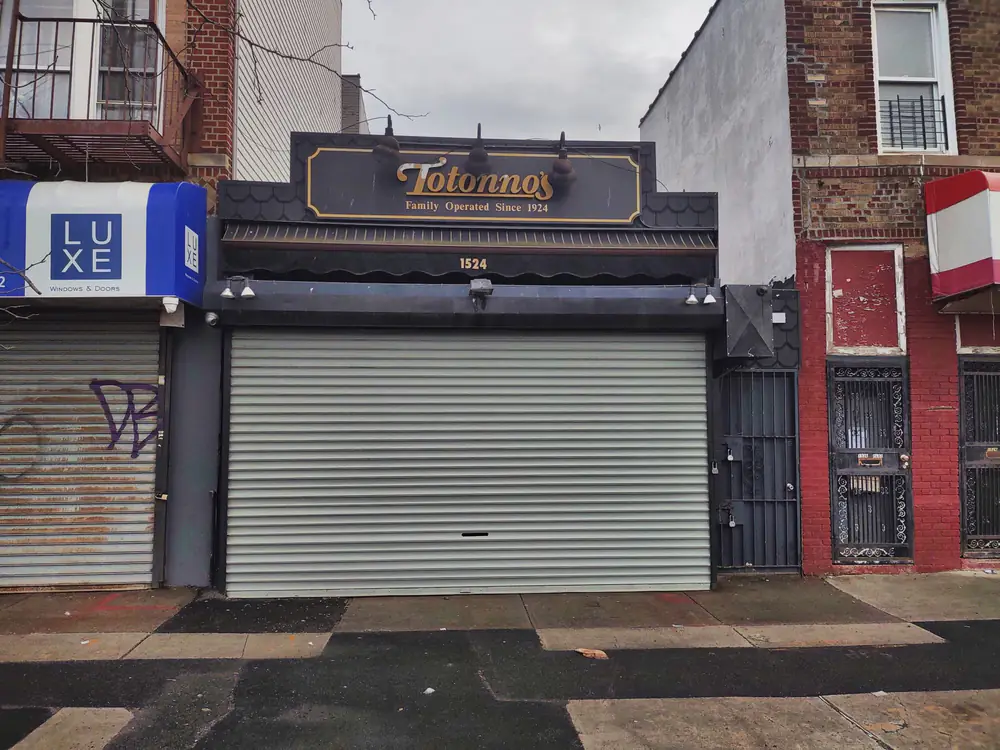

In 1924 a man named Antonio Pero left a job on Spring Street in Manhattan and opened his own place on Neptune Avenue in Coney Island. The job he left was at Lombardi's, generally credited as the first pizzeria in the United States, founded in 1905. The place he opened was Totonno's, after his own nickname. It is still there.
That single move is the origin of Brooklyn pizza as a distinct thing, and it explains most of what followed. Pero did not invent anything in Coney Island. He took a technique that already worked — coal-fired, high heat, tomato and cheese on a thin base — and put it somewhere else. Almost every important development in New York pizza for the next century follows the same shape: not invention, but a known method carried into a new neighborhood by someone who learned it under a specific roof.
Why coal, and why it stuck
The early New York pizzerias burned anthracite coal because that is what commercial bakeries burned. The ovens were not built for pizza; they were bread ovens, and the pizza was fitted to them. Anthracite gets very hot, burns with little smoke and holds a large masonry oven at temperature all day with modest attention.
What that produces is specific and recognizable: a floor hot enough to char the base in dark, bitter-edged patches, a dry radiant heat that crisps rather than steams, and a crust that shatters slightly at the edge instead of folding softly. The faint smokiness people attribute to coal pizza is mostly this — hard char and dry heat, not smoke flavor in the way a barbecue is smoky.
Why nobody builds a new coal oven
New York has effectively stopped permitting new solid-fuel coal ovens, and the survivors operate under grandfathered status. A coal oven in New York in 2026 is therefore an inheritance, not a choice. That is why the list of coal-oven pizzerias barely changes and why every one of them is old. We go into the fuel comparison in coal, wood, gas and deck.
The gas era and the birth of the slice
The thing most people outside New York picture when they hear "New York pizza" is not the coal-oven pie. It is the slice: an eighteen-inch round, low-moisture mozzarella, a sauce that has been cooked, sold by the wedge from a counter, foldable in one hand.
That is a post-war invention and it is a product of a different oven. Gas-fired deck ovens — stacked stone shelves, thermostatically controlled, running around 550–600 °F — arrived in volume after the Second World War. They are cheaper to install, far cheaper to run, need no fuel storage and can be left on all day at a steady temperature.
Everything about the New York slice follows from that oven. A lower temperature means a longer bake, six to ten minutes rather than ninety seconds. A longer bake means the dough dries more and the cheese browns rather than pooling, which is why the slice has structure and the Neapolitan pie does not. Low-moisture mozzarella exists because it survives that bake and reheats without weeping. The fold is a structural consequence of a large, thin, dried-out slice.
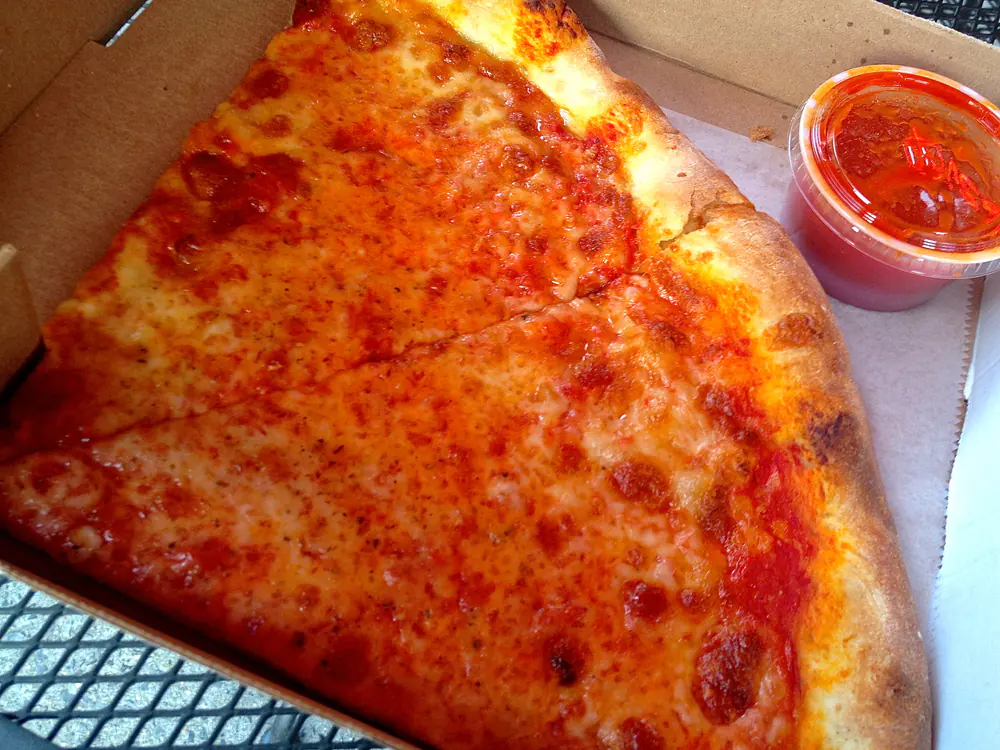

1965: Avenue J
In 1965 Domenico DeMarco opened Di Fara on Avenue J in Midwood. For decades it was a neighborhood pizzeria and then, slowly, it became a pilgrimage — largely because DeMarco kept making every pie himself, by hand, well into his eighties, at a pace that produced famously long waits and a genuinely singular product.
Di Fara matters historically for a reason beyond the pizza. It is the point at which New York pizza acquired the idea of the auteur — a single named person whose hand is the reason the thing is good, rather than a shop, a family or a neighborhood. DeMarco died on 17 March 2022. Di Fara continues under new ownership.
2006 onward: the Brooklyn revival
Three openings in six years reset what a Brooklyn pizzeria could be, and all three are still the reference points.
Lucali, Carroll Gardens. Mark Iacono opens in a former candy store on Henry Street. Cash only, no slices, no reservations, one room. The pizza is thin, restrained, and made in front of you.
Roberta's, Bushwick. A wood-fired oven in a cinder-block building on Moore Street, in a part of Brooklyn that had no restaurant economy at all. It became the template for a decade of openings.
Paulie Gee's, Greenpoint. Paul Giannone opens a wood-fired room on Greenpoint Avenue. Together with Roberta's it made New York a wood-fired destination rather than a coal-and-gas town.
The common thread is fuel. All three went back to fire — wood rather than coal, because wood is permittable where coal is not, and wood reaches Neapolitan temperatures where a gas deck oven does not. The revival was not nostalgia for 1924. It was a return to high, live heat using the one solid fuel the city still allows.
This is exactly the moment Pizza Moto starts, in 2008, and it is why a hand-built wood oven on a trailer made sense as a business rather than a stunt. The city had rediscovered what live fire does to a crust, and the barrier to entry was a building.
.jpg)
Where it stands now
Two recent developments say something about the direction of travel, and they point opposite ways.
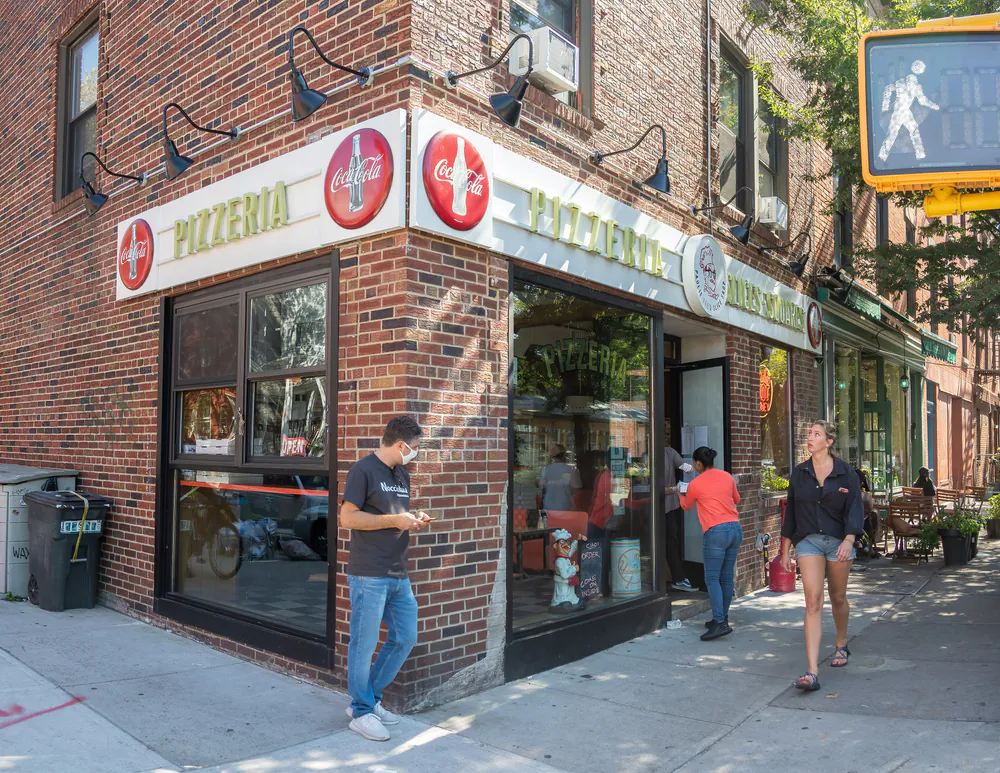
In December 2024, L&B Spumoni Gardens — the Bensonhurst institution whose Sicilian square with the sauce on top of the cheese is a genuinely distinct Brooklyn form — opened an outpost at 46 Old Fulton Street in DUMBO, directly across from Grimaldi's and Juliana's. Three landmark pizzerias on one short block, and a deep-southern-Brooklyn institution finally trading on the waterfront.
Meanwhile Paulie Gee's Greenpoint closed on 4 January 2026 for renovation and reopened that March as a tavern that does not carry the Paulie Gee's name — a 50-foot bar, booths, a jukebox and a pool table. The wood-fired ovens stayed and so did the pizzas, and Paul Giannone remains involved behind the scenes, but a place that was a destination for the pizza is now a neighborhood bar that happens to have very good pizza. The Slice Shop on Franklin Street carries on unchanged.
Read together: the old southern-Brooklyn forms are still expanding a century after Pero got off the train at Coney Island, while one of the rooms that defined the 2010s revival has quietly decided it would rather be a bar. Both of those are the borough behaving normally.
On “best”
This is a history, not a ranking. Where we name a pizzeria it is because it changed something, not because we are recommending your dinner. What we will do is walk you through a neighborhood and tell you what is actually there — see the crawl.