Ovens · Explainer
Coal, wood, gas and deck
Four ways to get heat into dough, and four different pizzas at the end of it. You can usually tell which one you are eating before you finish the first slice.
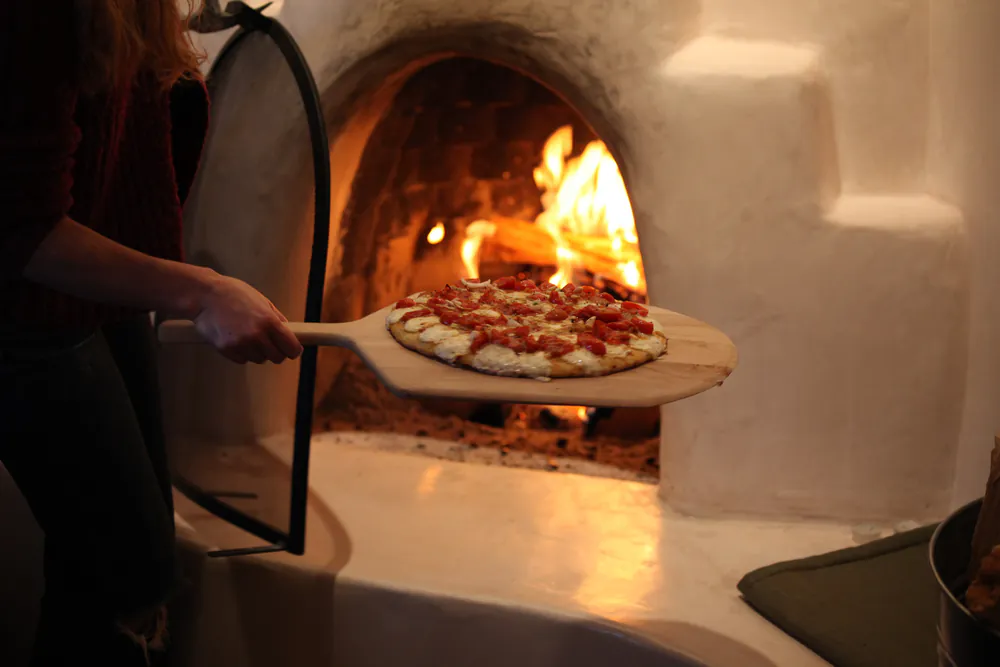

Everything a pizza oven does comes down to three numbers: how hot the floor is, how hot the air and the ceiling are, and how long the pizza is in there. Fuel matters because it determines what those three numbers can be. Style follows from the numbers, not the other way round.
Here is the short version, and then the long one.
| Oven | Typical floor | Bake time | What it gives you | Brooklyn status |
|---|---|---|---|---|
| Coal | ~800–900 °F | 3–6 min | Dry radiant heat; hard char in black patches; a crust that snaps at the edge rather than folding. | Grandfathered only. No new ones. |
| Wood | ~800–900 °F | 60–120 sec | Live flame across the dome; leopard-spotted puffed rim; a soft, moist center. | Permittable. The fuel of the revival. |
| Gas deck | ~550–600 °F | 6–10 min | Even, thermostatic, dry. Browned cheese, dried crust, a slice with structure. | The overwhelming majority of pizzerias. |
| Electric deck | ~600–750 °F | 3–7 min | Very controllable, separately adjustable top and bottom heat. No flame character. | Growing, especially where a flue is impossible. |
Coal: the inheritance
New York's first pizzerias burned anthracite because they were using bread ovens, and bread ovens burned coal. Anthracite is dense, nearly smokeless and very hot, and a big masonry coal oven will sit at temperature all day with periodic attention rather than constant feeding.
The signature is dry radiant heat. There is no live flame rolling over the pizza the way there is in a wood oven — the fire is a bed of glowing coal, and most of the energy arrives as radiation from the coal and the superheated masonry. That dries the surface of the dough hard and fast. A coal-oven crust does not puff into a pillowy Neapolitan rim; it goes rigid and crisp, with black char in flat patches where it met the floor.
.jpg)
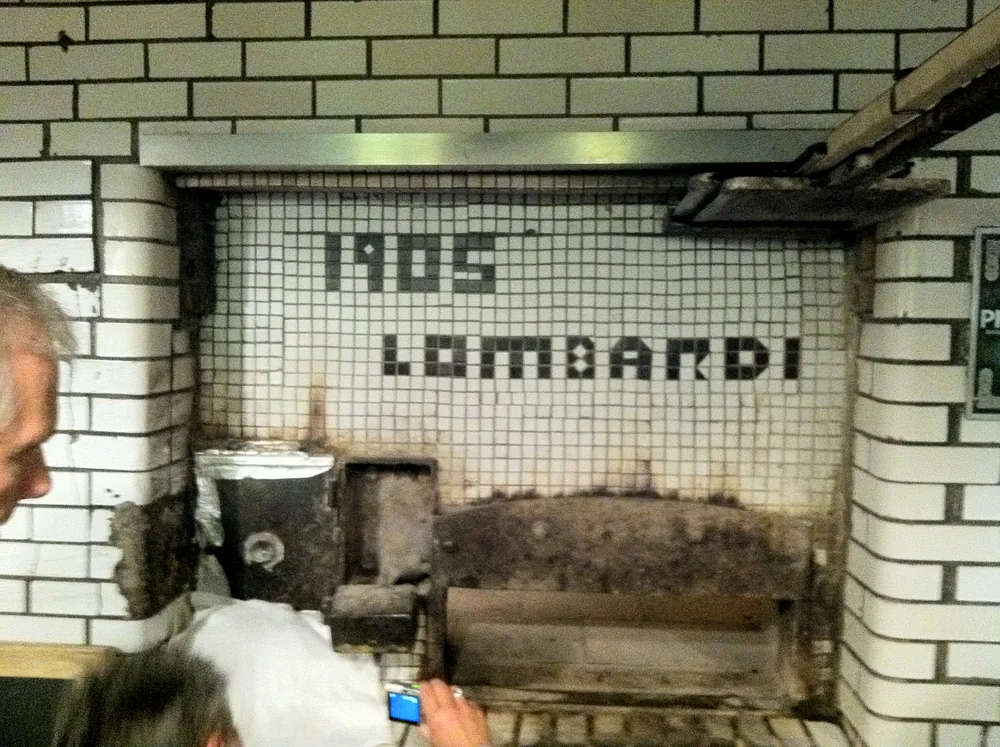
The reason this is a historical category rather than a live option is regulatory. New York has effectively stopped permitting new solid-fuel coal installations. The coal ovens still running — Totonno's on Neptune Avenue among them — operate on grandfathered status, which means the set of coal-oven pizzerias can only shrink. Every one of them is, by definition, old.
Wood: the revival
Wood is the one fuel that gets you coal-like temperatures and is still permittable, and that single regulatory fact explains the entire shape of Brooklyn pizza since 2006.
Wood behaves differently from coal in a way you can see. A wood fire has live flame, and in a properly run oven that flame is drawn up the wall and across the ceiling, so the top of the pizza is being cooked by moving fire and not only by radiation. That is what produces leopard-spotting — the irregular dark blisters on a Neapolitan rim — and it happens fast enough that the inside of the dough never fully dries. Ninety seconds in, the rim is puffed and charred and the center is still soft enough to be eaten with a knife and fork, which is exactly how it is served in Naples.
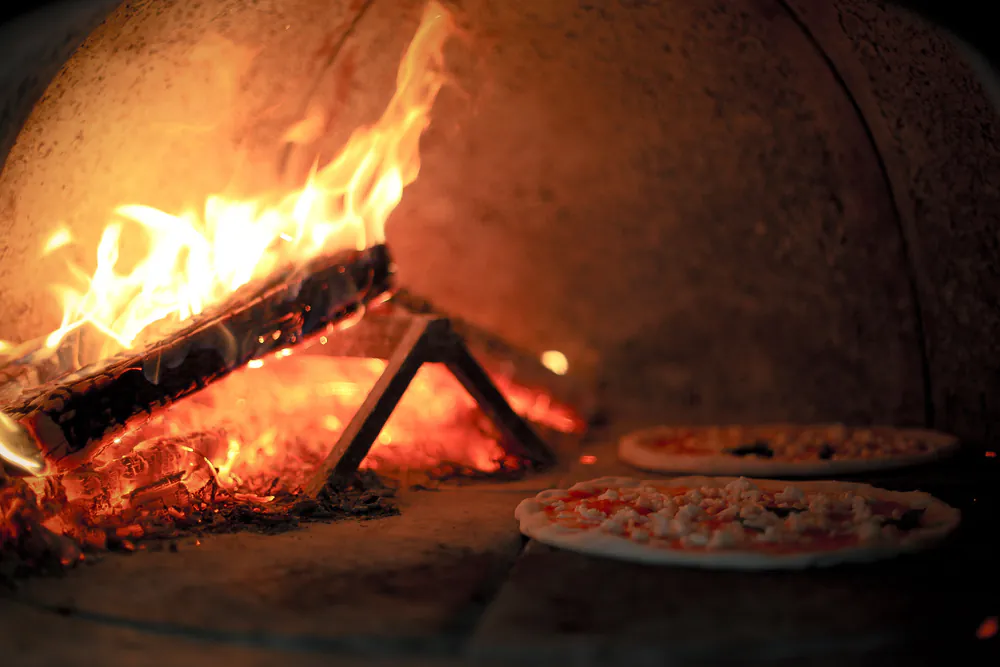

The trade-off is labour. A wood oven needs feeding, reading and managing all service. Temperature is controlled by how much wood is on and where the fire sits, not by a dial. You need dry seasoned fuel, storage for it, and a flue that satisfies the fire department. It is the most demanding option on this list by a distance, which is why the places that choose it tend to make a point of it.
The mobile problem
Put a wood oven on a trailer and you add a fourth constraint the list above does not cover: structure. A masonry dome is held together by compression, and a trailer subjects it to shock in every direction. Pizza Moto's first two ovens were destroyed by this before the third solved it by separating the two jobs — masonry for the hearth, a double-walled vault of insulated 12-gauge steel for the enclosure.
That design choice is not exotic. It is the same reasoning behind every modern portable wood oven sold today: steel shell, insulation, refractory floor. Pizza Moto arrived at it in 2009 by wrecking two ovens first.
Gas deck: the workhorse nobody writes about
Almost all the pizza eaten in Brooklyn on any given day comes out of a gas deck oven, and it deserves better press than it gets. A deck oven is a stack of stone shelves with burners, a thermostat, and a door. It holds 550–600 °F indefinitely, costs a fraction of a masonry oven to install and run, needs no fuel handling, and can be operated by someone on their second week.
Crucially, it makes a different and legitimate pizza rather than a worse one. At 550 °F an eighteen-inch round takes six to ten minutes. In that time the crust dries out properly, the low-moisture mozzarella browns and sets instead of pooling, and the whole thing acquires the tensile strength that lets you fold it. Every structural virtue of the New York slice — that it holds its shape, survives a reheat, and can be eaten walking — comes from the long bake in a moderate oven.
Try making a proper foldable slice in a 900 °F wood oven and you cannot. The rim chars before the middle dries and the slice flops. The two ovens are not competing at the same thing.
Electric deck: the quiet arrival
Electric deck ovens have got considerably better and considerably hotter. The good ones reach 700 °F and above and let you set top and bottom elements independently, which is a degree of control no fire gives you. They need no flue, which in a dense city is sometimes the deciding factor — a space with no chimney and no route to install one can still have a pizzeria.
What they do not give you is flame character. No live fire means no rolling flame across the top and no genuine leopard-spotting, though a very hot electric deck gets closer than most people expect. It is a real option now rather than a compromise, and the number of rooms using one is going up.
How to read a crust
You can usually work out the oven from the pizza in front of you.
- Puffed, irregular rim with dark blisters; soft, slightly wet center; served whole and small. Wood, around 900 °F, ninety seconds.
- Flat, rigid, snappy edge; black char in broad patches on the underside; browned but not pooled cheese. Coal.
- Large, thin, evenly golden; cheese browned and set; folds without breaking; reheats well. Gas deck.
- Even browning with very little char variation and a clean, uniform base. Probably electric.
And one more, which is not about fuel at all: if the sauce is on top of the cheese on a thick square, you are eating a Sicilian in the L&B Spumoni Gardens lineage, and the oven is almost beside the point. We get into that in the Brooklyn pie, explained.
The oven behind the wall
One last case, because it sits at the intersection of all of this. When Pizza Moto built out 338 Hamilton Avenue around 2013, they found a turn-of-the-century oven hidden behind the sheetrock. They restored its original cast-iron components and converted it from coal to wood.
That conversion is the whole argument of this page in one move. The masonry was already correct — a century-old oven built for anthracite is a superb thermal mass. What could not be reinstated was the fuel, because the city will not permit it. So the body stayed and the fire changed, and the pizza that came out was Neapolitan-style rather than the coal-oven pie the oven was born to make.