Neighborhoods · Routes
Four walks
Not a ranking and not a bucket list. Four routes, each built around a single thing it will teach you about how Brooklyn ended up eating the way it does.
.jpg)
Most pizza itineraries are lists of the best places, in descending order, with the distances between them treated as an inconvenience. This is the other thing. Each of these routes is short, walkable, and organized around one idea — and in every case the walk between the stops is doing as much explanatory work as the stops themselves.
Before you go
We publish no hours, no prices and no phone numbers, and we do not verify opening status on the ground. Everything here is drawn from documentary sources, and restaurants change. Check before you travel. See editorial policy for why we work this way.
Walk 1 / Old Fulton Street, DUMBO
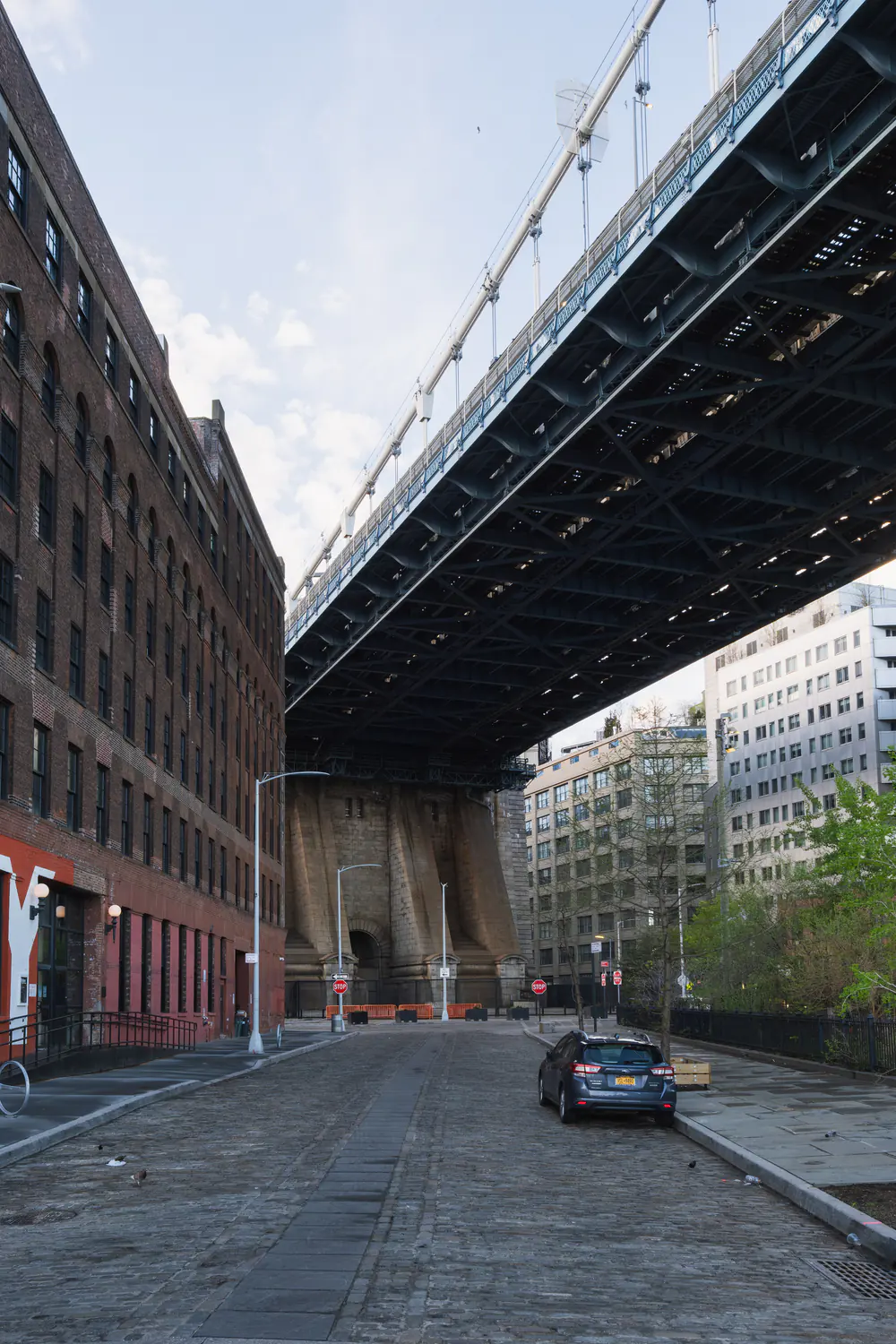
The shortest walk on this page, and the densest. Old Fulton Street, under the Brooklyn Bridge, holds Grimaldi's and Juliana's — coal-oven pizzerias with a shared and much-litigated history — and, since 8 December 2024, an outpost of L&B Spumoni Gardens at number 46, directly across the road.
That third arrival is what makes the block worth the trip. L&B is a Bensonhurst institution whose defining product is a thick Sicilian square with the sauce on top of the cheese — a deep-southern-Brooklyn form that had never had a waterfront address. Standing on that pavement you can see coal-oven Neapolitan-descended round pizza and pan-baked Sicilian square, from opposite ends of the borough and opposite ends of the century, facing each other.
Do this one when you want to understand that "Brooklyn pizza" is not one thing.

Walk 2 / Court Street to Hamilton Avenue
Start on Court Street in Carroll Gardens, where F&F Pizzeria sits at 459 in a converted garage between the Franks' two other businesses — counter service, slices, open in the daytime, no ceremony.
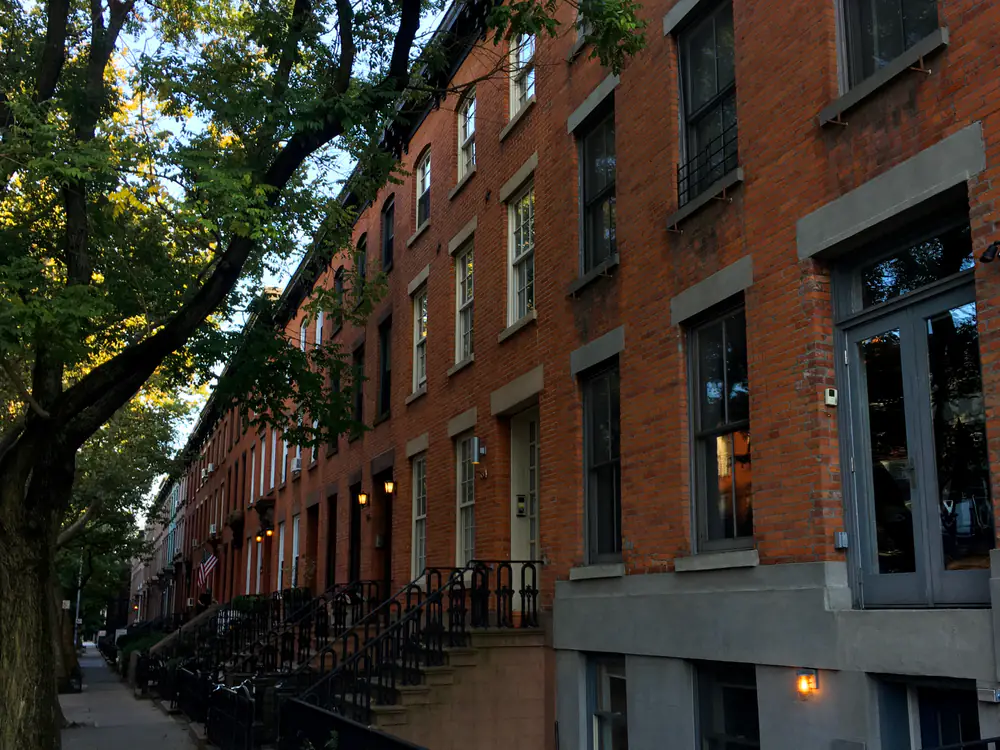
Walk west into the numbered streets and look at the front gardens. They are unusually deep, they are the reason the neighborhood has its name, and they are a nineteenth-century surveying decision you can still see from the pavement.
Continue to 575 Henry Street and look at Lucali from the outside. If it is late afternoon there will be a line. Cash only, no reservations, no slices, one room. Three blocks from F&F and a completely opposite theory of what a pizzeria is for.
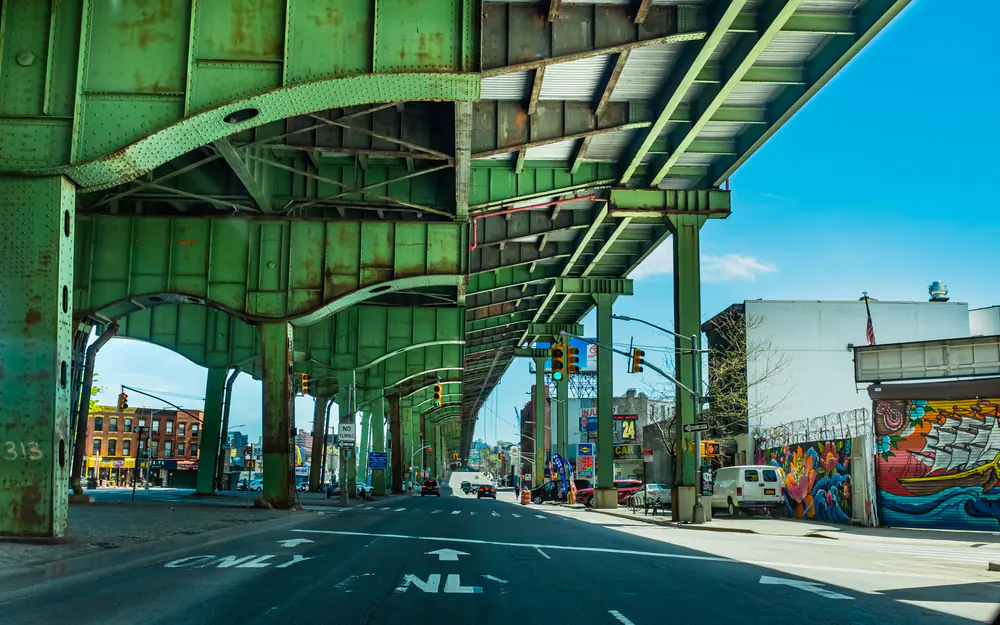
Then keep going south-west until you are under the Gowanus Expressway on Hamilton Avenue. This is the part of the walk that matters. The change is abrupt — brownstones and trees, then a dark elevated roadway, then low commercial buildings and a working harbor beyond. 338 Hamilton Avenue, between Centre and Mill, is where Pizza Moto found a turn-of-the-century oven behind a wall and ran a restaurant from 2015 until February 2023.
Five minutes of walking separates two neighborhoods that developed on entirely different trajectories, and the reason is directly over your head. Red Hook explains it in full.

Walk 3 / Greenpoint Avenue to Franklin Street
Walk from the stretch of Greenpoint Avenue where Paulie Gee's opened in 2010 down to the Paulie Gee's Slice Shop on Franklin Street, and you are walking between the two formats a serious pizza operation can take.
There is a timely complication, which is the point of including it. The Greenpoint room closed on 4 January 2026 for renovation and reopened that March as a tavern that no longer carries the Paulie Gee's name — bar, booths, jukebox, pool table. The wood ovens and the pizzas stayed; Paul Giannone is still involved behind the scenes. The Slice Shop on Franklin Street was untouched and trades on as before.
So this walk now runs from a room that has decided to be a bar with excellent pizza, to a counter that has been unambiguously a pizza counter the whole time. That is a genuinely instructive fifteen minutes about what a neighborhood actually sustains, as against what a magazine says it wants. More on north Brooklyn.
Walk 4 / Neptune Avenue, Coney Island
A pilgrimage rather than a crawl. Totonno's has been on Neptune Avenue since 1924, opened by Antonio Pero, who learned the trade at Lombardi's on Spring Street before leaving to work for himself. It is a coal oven, it is the oldest continuously significant pizza address in Brooklyn, and it is the origin point for everything on this page.
Go out on the train, look at the ocean, and register that the entire hundred-year Brooklyn pizza story starts at the far end of the line rather than anywhere fashionable. Totonno's has been through fire, flood and repeated searches for new ownership — as of December 2025 it was reported to be looking again — so this is the one walk on this page where checking first genuinely matters.
What the four have in common
Each route is built on a piece of infrastructure rather than a restaurant: a bridge approach, an elevated expressway, a subway line, the end of the D train. Brooklyn pizza is not distributed according to where the good cooks are. It is distributed according to where the cheap space was, where the flues were legal, and where the crowds could get to — and those are all decisions made by engineers decades before anybody lit an oven.
Which is the argument of the history, compressed into four afternoons of walking.