Pizza · Explainer
The Brooklyn pie, explained
Five different things get called pizza in this borough. They are made differently, they are eaten differently, and arguing about which is best is a category error.
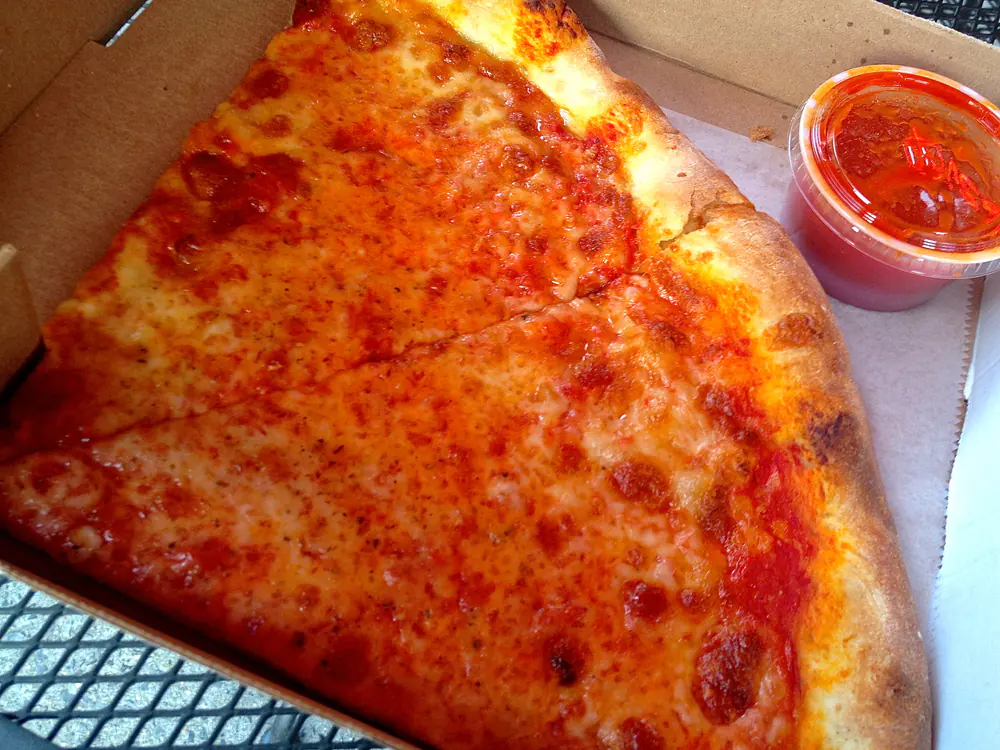

Ask for pizza in Brooklyn and you will be handed one of about five distinct objects depending on where you are standing. They share a name and not much else. The differences are not regional branding — they come from different ovens, different cheeses and different amounts of time, and once you can see the mechanism the categories stop being arbitrary.
01 / The slice
What it is: an eighteen-inch round cut into eight wedges, sold by the wedge, reheated on demand.
Low-moisture mozzarella, a cooked sauce, a thin base, and six to ten minutes in a gas deck oven at around 550 °F. Everything about it is a consequence of that bake. The long time at moderate heat dries the crust into something with real tensile strength, browns the cheese instead of pooling it, and produces a slice that survives sitting on a counter, survives a reheat, and can be folded lengthwise and eaten with one hand while walking.
The fold is the tell. A slice that cannot be folded without cracking is overbaked; one that flops open entirely is underbaked or too wet. There is a narrow band where it hinges and holds, and a good slice shop hits it all day.
On the reheat
A slice reheated properly on a deck oven stone is not a lesser version of a fresh one — it is a slightly different and often better thing, because the second bake drives off more moisture and re-crisps the base. A slice reheated in a microwave is a tragedy. The distinction is worth caring about.
02 / Neapolitan
What it is: a personal-sized round, served whole, eaten with a knife and fork, gone in ten minutes.
Fresh mozzarella, raw crushed tomato, a soft high-hydration dough, and sixty to ninety seconds in a wood oven at 800–900 °F. The rim puffs because the water in the dough flashes to steam faster than the crust can set. The dark blisters — leopard-spotting — are where rolling flame touched the surface. The center stays soft and slightly wet, which is correct and not a fault, and it is why the pizza is served whole and not cut.
The thing to understand is that this pizza is engineered to be eaten immediately. It has no structural reserve. Four minutes after it leaves the oven the base has absorbed moisture from the tomato and it will not hold its own weight. That is not a defect; it is a design that assumes you are sitting down in front of it.
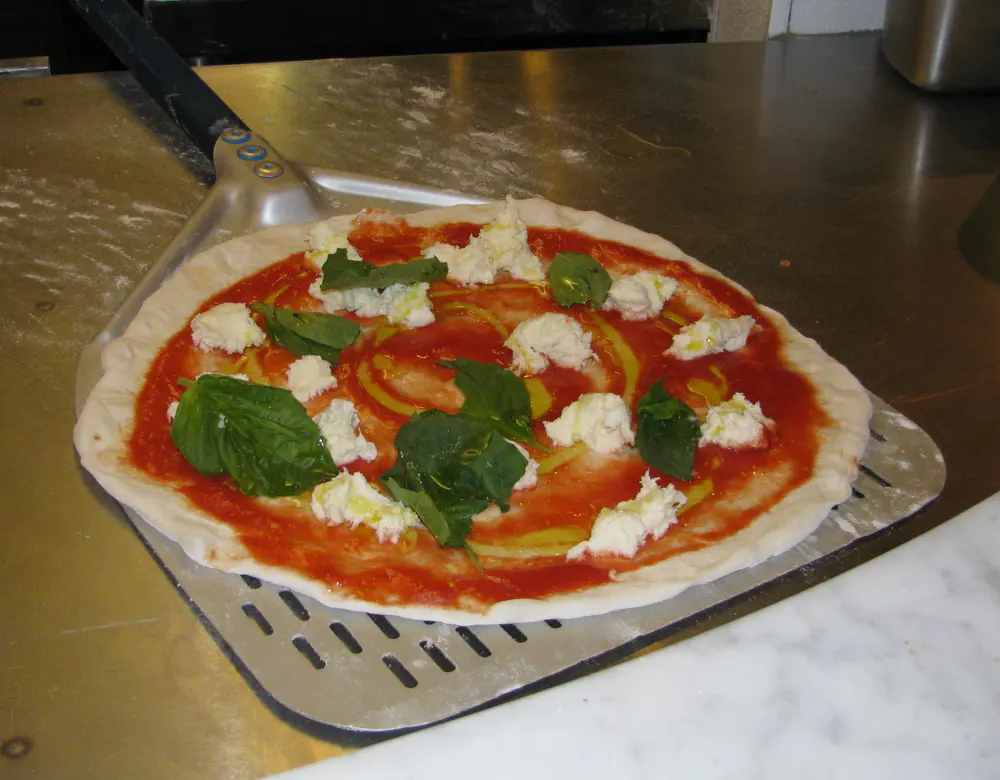

This is the style Pizza Moto worked in from a trailer — "pies are small, Neapolitan style," as New World Review put it in 2010 — and small was partly a choice and partly what a mobile hearth could deliver.
03 / The Sicilian square
What it is: a thick rectangular pie baked in an oiled steel pan, cut into squares.
The dough proofs in the pan, so it is airy and bready rather than thin and crisp, and because the pan is oiled the bottom effectively fries as it bakes. A good Sicilian has a base that is golden and slightly crunchy in a way that is closer to a fried bread than a baked one, under a crumb that is open and soft.
The Brooklyn benchmark is L&B Spumoni Gardens in Bensonhurst, and their square has a defining peculiarity: the sauce goes on top of the cheese. Mozzarella on the dough first, then sauce over it, then grated cheese. It is not an eccentricity for its own sake. Burying the cheese under sauce stops it browning and drying during a long pan bake, so it stays molten, while the sauce on the surface concentrates and sweetens.
In December 2024, after decades as a strictly southern-Brooklyn proposition, L&B opened a second location at 46 Old Fulton Street in DUMBO — across the street from Grimaldi's and Juliana's, which makes that block the densest concentration of landmark pizza in the borough.
04 / The grandma
What it is: also a pan square, and not the same thing as a Sicilian.
The difference is proofing. A Sicilian dough sits in the pan and rises, producing height. A grandma is pressed thin into the pan and baked with little or no second rise, producing something flat, dense-edged and crisp — closer to the ratio of a thin round than to a focaccia. The toppings tend to go on in a looser, less uniform way: torn mozzarella in patches rather than a full blanket, sauce in stripes or spoonfuls, garlic and oregano visible.
Grandma slices have become the default "second option" at a lot of counters that would once have offered only round and Sicilian, and the good ones are very good indeed. Farina, which took over the former Pizza Moto space on Hamilton Avenue in August 2023, built its menu on southern-Italian grandma-style pizza before closing in 2025.
05 / The bar pie
What it is: a small, very thin round, cheese taken right to the edge, cut into narrow wedges.
Less common in Brooklyn than in New Jersey and Connecticut, but it turns up, and it is worth recognizing. There is essentially no rim — the cheese and sauce run to the perimeter, so the edge caramelizes against the pan or stone into a hard, salty lace. It is engineered to be eaten with a drink, in quantity, by several people.
The comparison, straight
| Style | Oven & time | Cheese | Structure | Eat it |
|---|---|---|---|---|
| Slice | Gas deck, 6–10 min | Low-moisture | Strong; folds | Standing, one hand |
| Neapolitan | Wood, 60–120 sec | Fresh | Soft; no reserve | Immediately, seated |
| Sicilian | Oiled pan, long | Under the sauce | Tall, airy, fried base | By the square |
| Grandma | Oiled pan, no second rise | Torn, patchy | Thin, crisp-edged | By the square |
| Bar pie | Deck or stone, small | To the edge | Cracker-thin, laced edge | In quantity, with a drink |
The argument you should not have
People spend a lot of energy insisting that one of these is real pizza and the rest are deviations. It is a waste of a good subject. A Neapolitan pie and a corner slice are solving different problems: one assumes you are sitting down with ten minutes and a fork, the other assumes you are on a sidewalk with ninety seconds and one free hand. Judging either by the other's criteria tells you nothing except which one the judge grew up with.
The interesting question is never which is best. It is why a given neighborhood ended up with the mix it has — which is what the neighborhood pages are for.