Pizza · Restored legacy address
The Ingredients
A Margherita has four things on it. That is the whole difficulty. There is nowhere for a bad tomato to hide.
The original page at this address has not survived with its text intact — the Internet Archive's November 2009 capture preserves the iWeb frame and the navigation, but not the words. What survives instead is what other people wrote down while watching the stall work, and that turns out to be enough to be specific.
From the archive · what was recorded in 2009–2010
A wild-yeast sourdough starter cultured from local apples. Pies small, Neapolitan style. Each one finished off the peel with grated grana padano and extra-virgin olive oil, then cut into quarters.
That last detail — grana and oil after the bake, at the table rather than in the oven — is the kind of thing that only shows up when someone is standing there watching. It is also the correct order of operations, and worth explaining.

Tomato
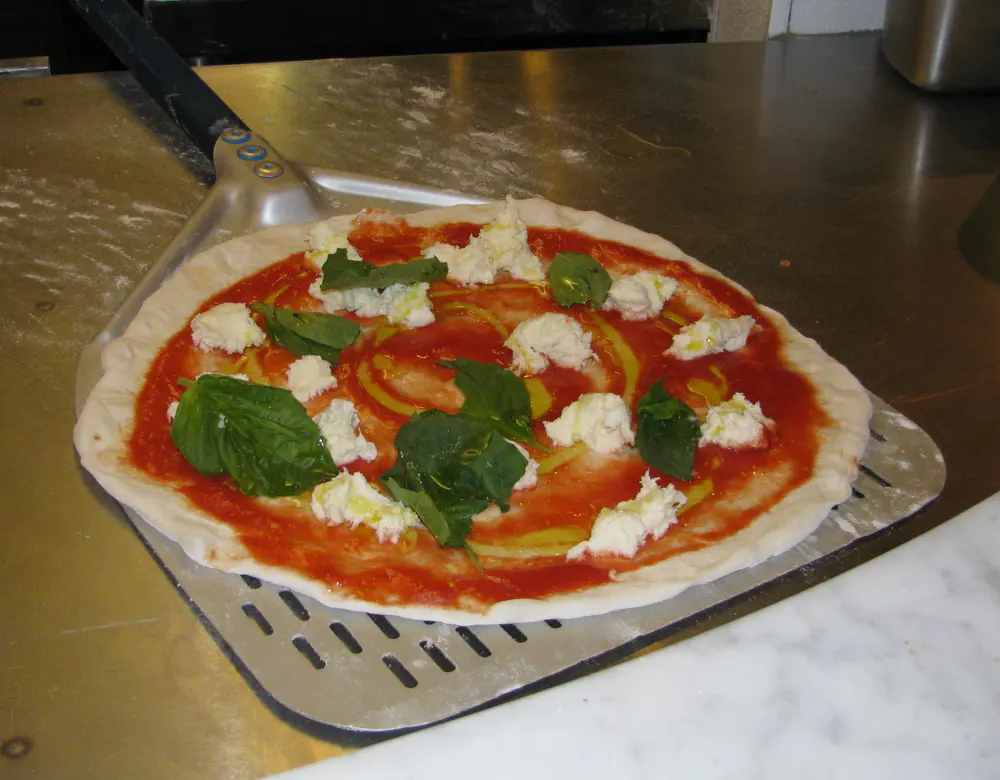
On a Neapolitan-style pie the tomato is not cooked before it goes on. It is crushed raw, salted, and put on the dough, and the ninety seconds in the oven is the only cooking it gets. There is no simmering down, no garlic, no oregano, no sugar to cover a thin tomato.
This is why the canned tomato is a genuine decision rather than a shopping detail. San Marzano varieties grown in the volcanic soil around Vesuvius are the traditional reference — low in seeds, low in acid, dense in flesh — and the DOP designation exists precisely because the name gets borrowed. Plenty of excellent pizza is made with other tomatoes. Very little good pizza is made with watery ones.
Mozzarella
Two families, and they behave completely differently.
| Type | What it is | In the oven |
|---|---|---|
| Fresh mozzarella (fior di latte, bufala) | Cow or buffalo milk, high moisture, stored in liquid | Melts into pools, releases water, gives the wet-and-milky Neapolitan look. Needs draining or it floods the pie. |
| Low-moisture mozzarella | Aged and dried, the block behind every slice counter in New York | Melts evenly, browns, stretches, and holds a slice together under a fold. The backbone of the New York slice. |
A Neapolitan-style operation uses the first. A corner slice shop uses the second. Neither is a compromise; they are answers to different questions, and the tell is what happens when the pizza cools.
Grana, and why it goes on last
Grana padano is a hard aged cow's-milk cheese from the Po valley — Parmigiano-Reggiano's close relative and, for most purposes, its more affordable cousin. Grated over a pizza as it comes off the peel, it does something specific: it melts from residual heat rather than oven heat, so it stays granular and salty rather than turning to a browned crust.
Put the same cheese on before the bake and it scorches. Aged hard cheeses have very little water and a lot of protein and fat; at 900 °F they burn before the crust is done. The order is not fussiness. It is the difference between savory and acrid.
The same logic governs the olive oil. A good peppery extra-virgin has volatile aromatic compounds that are the entire reason to buy it, and they do not survive a wood oven. Finishing oil is applied at the end, off the heat, or it may as well be any oil at all.
Basil, briefly
Basil goes on before the bake in Naples and emerges half-wilted and dark at the edges, which is traditional and correct. It goes on after the bake in plenty of good New York kitchens and stays green and aromatic. Both are defensible. Anyone who tells you one is the only way is selling something.
Sourcing, later
By the time Pizza Moto had a restaurant, the sourcing had become part of the menu's identity: a rotating list of toppings drawn from farmers' markets and New York State pasture-raised meat producers, alongside composed plates that made sense of Dave Sclarow's fine-dining background. That is a different operation from a trailer at a flea market, but it is the same instinct — a short list of things worth the space.
For what happens underneath all of it, see The Dough.