Ovens · Restored from the archive
The Oven
Two brick ovens died on the streets of New York before this one worked. The fix was not better masonry. It was a steel box built like a ship.
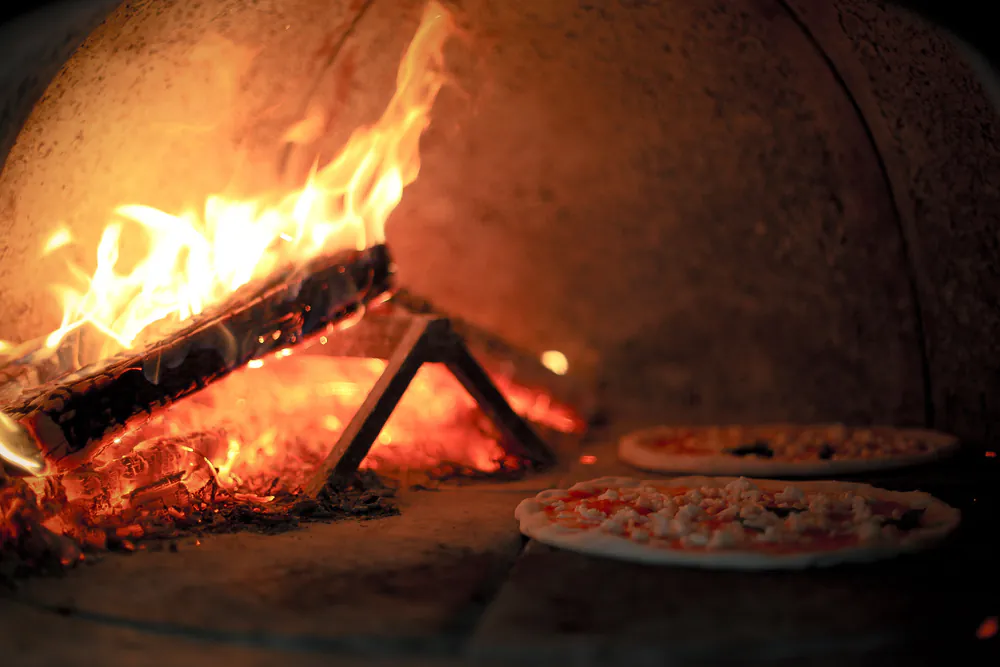

This address used to hold a short paragraph of plain text. Between 2009 and roughly 2011, pizzamotobklyn.com/The_Oven.html was where Pizza Moto explained the machine it had built — a wood-fired brick oven that could be towed through New York City without disintegrating. The paragraph is worth restoring, because it describes an engineering problem most pizza writing skips straight past.
Here it is, exactly as it stood on the page in September 2009.
From the archive · pizzamotobklyn.com/The_Oven.html
"The story of the oven: This is this the third PizzaMoto pizza oven so far. The previous two were crude brick and mortar structures that lasted only a few weeks aboard the trailer. The punishment from NYC's streets quickly reduced them to shattered piles of rubble. This oven is a vast departure from its more traditional predecessors. It has a masonry hearth that soaks up the heat of the fire to produce thin crispy bubbly crusts, but instead of the heavy fragile brick and mortar enclosure, this oven is made from a double walled vault of insulated 12 gauge diamond plate steel! It is a much stronger and lighter structure that solves the problem of how to make a light weight wood-fired brick oven that can travel safely across the streets of NYC or anywhere that's connected to a road."
Why the first two ovens died
A traditional wood-fired oven is a masonry object that works because it is heavy. Fire is burned inside a dense enclosure for hours; the mass absorbs the energy and then gives it back slowly through the floor, which is what cooks the base of a pizza in ninety seconds. The dome reflects flame down onto the top. Nothing about that arrangement is clever. It is just physics applied to several hundred kilograms of clay and stone.
The problem is that brick and mortar are strong in compression and close to useless in tension. A masonry dome sitting on the ground is under compression everywhere, which is why ovens built in the eighteenth century are still standing. Put the same dome on a trailer and you have introduced something masonry has no answer for: repeated shock loads in every direction at once.
The specific enemy
Belgian block, expansion joints, potholes, and the seam where a bridge meets its approach. A trailer amplifies all of it. Every impact tries to shear the mortar joints, and mortar that has been thermally cycled to 800 °F and back is already brittle. The archive's phrase — "shattered piles of rubble" — is not hyperbole. It is the expected failure mode.
So Pizza Moto's first two ovens were not badly built. They were correctly built, for the wrong application. You cannot fix that with more mortar or better bricks. The load case is simply outside what the material does.
The third oven: separate the two jobs
The design described in 2009 works because it stops asking one material to do two things. A wood oven has to (a) store heat and (b) contain it inside a structure. Masonry is superb at the first and fragile at the second. So the third oven kept masonry for the hearth — "a masonry hearth that soaks up the heat of the fire" — and handed the structural job to steel.
The enclosure became, in the original wording, "a double walled vault of insulated 12 gauge diamond plate steel." Three things are doing work in that sentence:
- 12-gauge is roughly 2.7 mm sheet steel. Heavy enough to be genuinely structural, light enough not to defeat the point.
- Double-walled and insulated means the two skins are separated by an insulating layer. The outer skin stays touchable, the inner skin and the hearth stay hot, and the oven holds temperature between one service and the next.
- Diamond plate — the raised-pattern steel used on truck beds and stair treads — is stiffer than flat sheet of the same thickness, because the pattern resists panel flex. It is also, frankly, what the material looks like: this was a thing built out of what a working New York fabricator can get.
The result, per the archive, was "a much stronger and lighter structure." Lighter matters twice over. It is the difference between a trailer that is legal and towable and one that is neither, and it is the difference between an oven that reaches temperature in a reasonable time and one that needs to be fired the night before.

What it produced
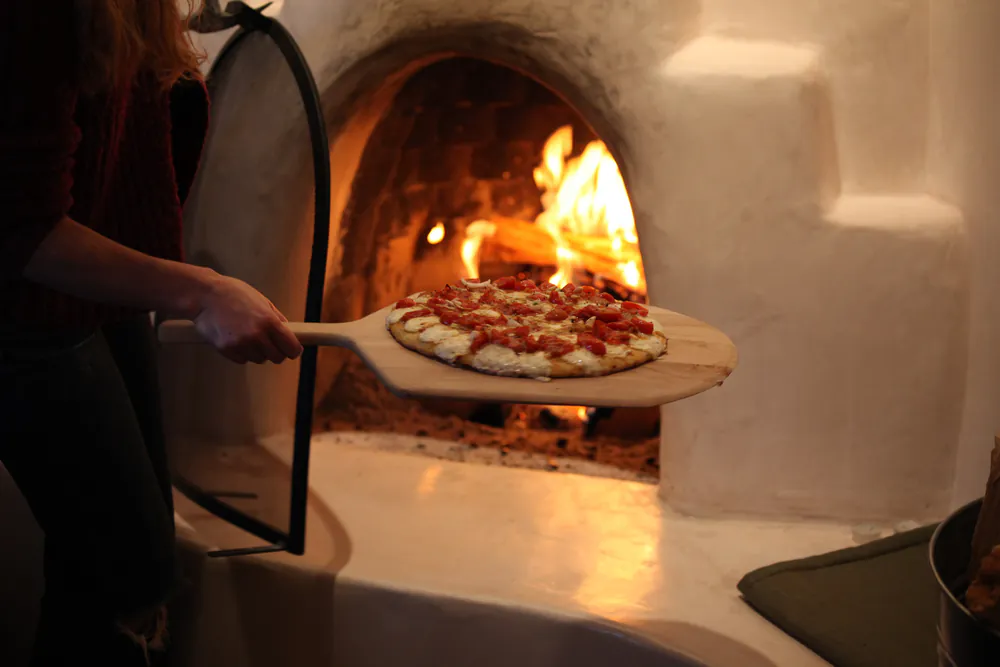
The archive is specific about the goal: "thin crispy bubbly crusts." That is a description of a fast bake — a floor hot enough to set the base before the interior dries, and a dome hot enough to blister the rim.
Contemporary accounts line up. Writing in April 2010, Nicholas Gill described the operation in New World Review's survey of Brooklyn Flea food: "A portable wood fired brick oven is the secret to this mobile pizza shop that turns up at the flea, as is the sourdough starter made from the wild yeast found on local apples. Pies are small, Neapolitan style." Mobile Food News, that December, watched the crew work off a folding prep table, finishing each pie with grated grana padano and olive oil before cutting it into quarters.
Small pies are not a stylistic affectation here — they are what the equipment allows. A mobile hearth has limited floor area and limited recovery. Small, fast, and repeatable beats large and slow when there is a line in front of you and the only heat source is the wood you brought with you.
The dough deserves its own page, and has one: the apple-yeast starter and the three-day ferment.
The second oven that matters
There is a coda to this, and it is a good one. In October 2015, Pizza Moto opened a permanent restaurant at 338 Hamilton Avenue, under the Gowanus Expressway on the Red Hook side of Carroll Gardens. During the build-out they found a turn-of-the-century oven hidden behind a wall of the abandoned storefront.
They restored its original cast-iron components and converted it from coal to wood. So the business that began by building a portable oven because it could not have a fixed one ended up with a fixed oven older than almost anything else on the block — and burning the same fuel as the trailer.
That story is told in full on the Pizza Moto history page, and the coal-to-wood conversion is worth understanding on its own terms; we cover it in coal, wood, gas and deck: the four ovens of Brooklyn.
Why this page exists at this address
Links to /The_Oven.html were made by publications that no longer maintain them, and the paragraph they pointed at disappeared when the domain lapsed. Rather than redirect the path somewhere prettier, we kept it and put the original text back, in context. The sources and method page explains how the archive was recovered.