History · Restored legacy address
The Brooklyn Flea
A schoolyard on Lafayette Avenue, a hundred vendors, and a business model that let a cook test an idea without signing a fifteen-year lease.
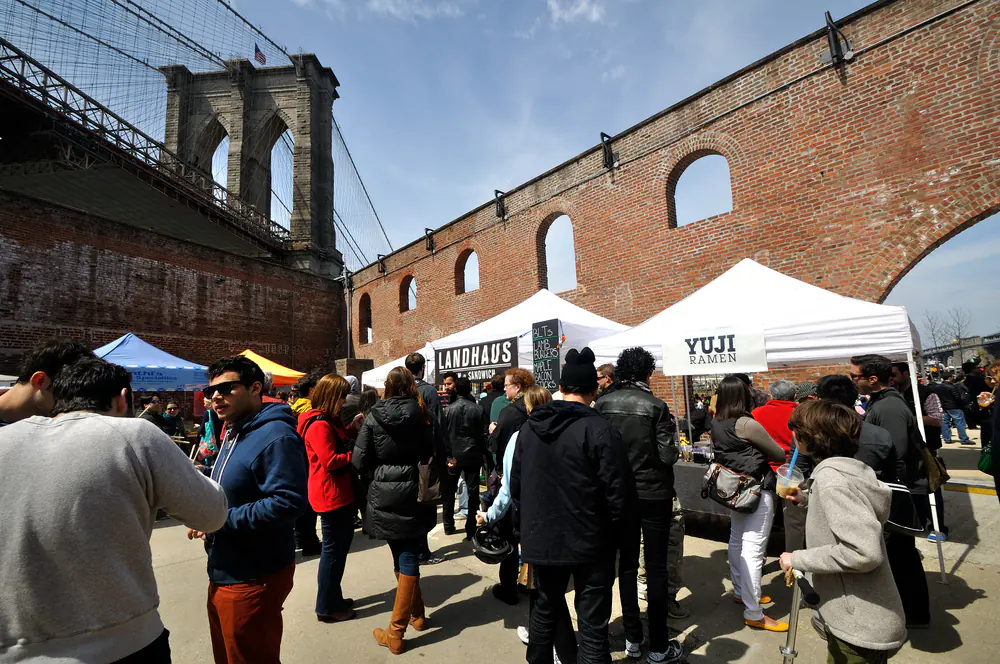

The page that used to sit at this address was not an essay. It was directions. Pizza Moto's site kept a Brooklyn Flea page whose entire content was how to get there: the A/C to Lafayette Avenue, the G to Clinton–Washington, the B69 up Vanderbilt, and a set of driving instructions off the BQE ending "turn left on Vanderbilt Avenue for four blocks until Lafayette Avenue."
Those directions are the most useful thing in the archive, because they pin the location exactly. Lafayette and Clermont, Fort Greene — the schoolyard of Bishop Loughlin Memorial High School, where the Brooklyn Flea started in April 2008. Pizza Moto was there by that September.
What the Flea actually was
Jonathan Butler and Eric Demby launched the Brooklyn Flea as a weekend market for antiques, vintage clothing, furniture and craft. Food was there from the start but as a service to shoppers, the way food is at any market. Over the following two or three years the ratio inverted, and not because anyone planned it.
The reason is mostly arithmetic. Opening a restaurant in New York in 2009 meant a lease, a build-out, a liquor license if you wanted one, kitchen equipment, staff, and a burn rate starting on day one — call it six figures before a single plate leaves the pass, and that is conservative. A stall at a weekend market meant a table fee.
For a cook with an idea and a day job, that gap is the whole story. Dave Sclarow was chef de cuisine at Lunetta in Cobble Hill while running Pizza Moto at the Flea on weekends. The market was not a lesser version of a restaurant. It was the only structure that made the experiment survivable.
Constraints, and what they produced
Market trading imposes a specific discipline, and the food that came out of Brooklyn Flea has its fingerprints all over it.
- One thing, done properly. A stall has a table's worth of space and no walk-in. You sell one item, or a very short list. It is the opposite of a menu that hedges.
- It has to be eaten standing up. No cutlery, no plate that needs a table, nothing that collapses after ninety seconds in the hand. Pizza is close to ideal here — and small pizza, cut in quarters, more so.
- Everything arrives with you. No gas line, no three-phase power, no water hookup you can count on. This is precisely why Pizza Moto ended up welding a masonry hearth into a steel vault: the constraint was towing, and the answer was engineering.
- You meet every customer. A market vendor has one conversation per sale, all day, every weekend. Ideas that cannot be explained in a sentence do not survive contact with that.
That last one matters more than it sounds. "The starter is wild yeast off local apples" is a good sentence. It is memorable, it is true, and it is the reason two separate publications recorded it in 2009 and 2010. A market teaches you which sentence that is.

.jpg)

2011: Smorgasburg, because of a space problem
By 2011 the food side had outgrown the market that hosted it. There were more food vendors who wanted in than the Flea had room for. Butler and Demby's answer was to spin food out into its own market: Smorgasburg, launched on the Williamsburg waterfront in 2011.
It is worth being clear that this was a capacity decision before it was a branding one. The food had simply become too big to be a sideline at a flea market. Smorgasburg went on to become the largest weekly open-air food market in the United States and a recognized launchpad — the place where a stall became a chain often enough that people started treating it as a career path rather than a weekend.
Pizza Moto worked both. The 2010 homepage listed Brooklyn Flea, Central Park and SummerStage as destinations; Smorgasburg joined after it launched.
The pattern, in general
What Brooklyn Flea and Smorgasburg changed was the order of operations for opening a food business. The old sequence was: raise money, sign lease, build restaurant, find out if people like it. The new one was: build the smallest possible version, sell it every weekend, find out if people like it, and only then decide whether a lease is worth it.
Pizza Moto ran that sequence exactly. Seven years at markets, then a storefront on Hamilton Avenue in October 2015 — and when the lease came up in 2023, the business went back to what it had been before, as a wood-fired catering company. The trailer was never the apprenticeship for the restaurant. It was the durable form, and the restaurant was the experiment.
Why the directions are gone
We have not reproduced the 2009 travel directions as live information. Market locations, days and subway service have all changed since, and stale directions are worse than none. The original page’s routing is described above as history, and Brooklyn Flea and Smorgasburg publish current locations themselves.