Pizza · Restored legacy address
The Dough
Wild yeast off the skin of an apple, three days in the cold, and a rim that puffs before it burns. The least visible part of a pizza does most of the work.
Pizza Moto's original site had a page at this address called The Dough. By the time the Internet Archive got to it in December 2009 the text had gone and only the layout survived — an iWeb shell with the words stripped out. So unlike The Oven, we cannot put the original words back. What we can do is say what the dough actually was, because two separate publications wrote it down at the time.
Both agree on the unusual part. From Martha Stewart's blog, October 2009: the Margherita was "made with a sourdough starter procured from local apples." From New World Review the following April: "the sourdough starter made from the wild yeast found on local apples."
Why an apple
The dusty bloom on an unwashed apple is not dust. It is a film of wild yeasts and bacteria that live on the fruit's skin — Saccharomyces, Hanseniaspora, lactic acid bacteria, and a long tail of others depending on the orchard, the season and the weather. It is the same population that makes cider ferment if you leave juice alone in a bucket. Wine grapes carry an equivalent bloom, which is what "wild ferment" means on a bottle.
Capture that population in a flour-and-water slurry, feed it, and within a week or so the organisms that can live on starch outcompete the ones that cannot. What remains is a starter: a stable, self-renewing culture of yeast and lactic acid bacteria.
What the apple actually contributes
Less than the romance suggests, and more than nothing. Most of a mature starter's character comes from how it is fed and held — hydration, flour, temperature, feeding rhythm. But the founding population does shape the early culture, and starting from fruit rather than flour alone is a real choice with a real flavor consequence. It is also a very legible one for a market stall: it gives a stranger a reason to ask a question.
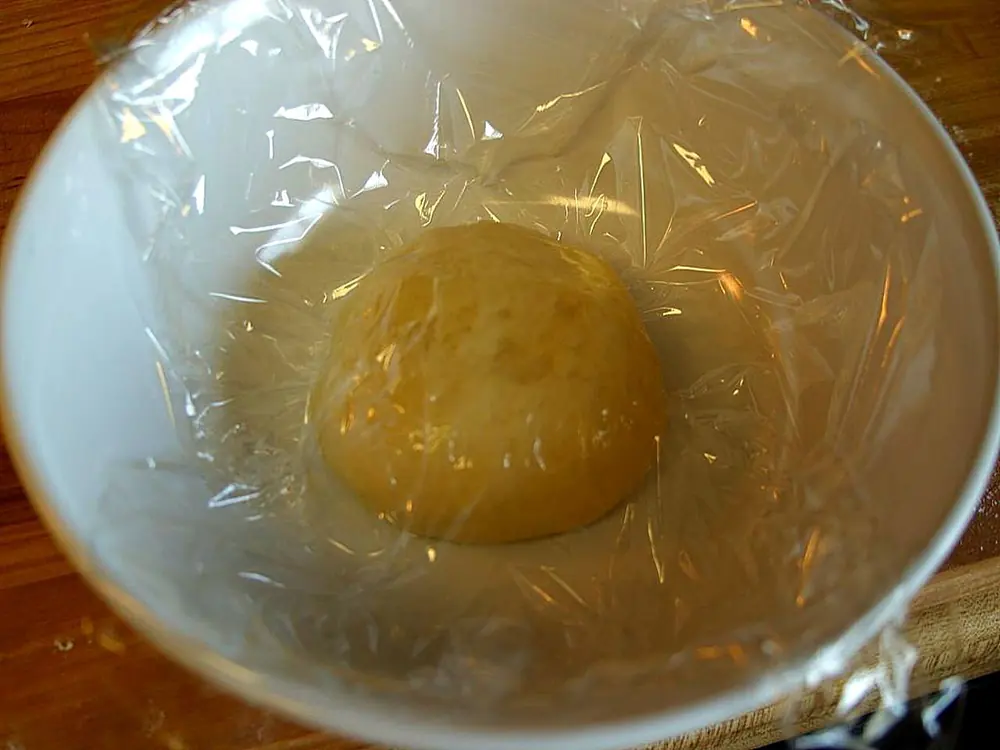

What three days do
When Pizza Moto opened the Hamilton Avenue restaurant, the dough was reported to go through three days of slow fermentation. That is a long ferment by pizzeria standards, and it is doing several jobs at once.
Flavor
Yeast makes carbon dioxide and ethanol. Bacteria make lactic and acetic acid. Enzymes in the flour break starch into simpler sugars and protein into amino acids and peptides. Given hours, you get gas. Given days in the cold, you get the acids and the amino acids too, and those are what a long-fermented crust tastes of — a faint sourness and a savory depth that a four-hour dough simply has not had time to build.
Structure
Gluten develops on its own over time, without kneading, as long as the flour is hydrated. A cold three-day dough can be handled very gently and still have the extensibility to stretch thin without tearing and the strength to hold a rim.
Browning
This is the part that matters most in a wood oven. Sugars liberated by enzymes during fermentation are fuel for browning. At 800–900 °F a pizza is in the oven for ninety seconds; there is no time for slow color development. Either the dough arrives with enough available sugar to brown and blister in that window, or it comes out pale. The leopard-spotting on a Neapolitan rim is not a sign of a hot oven alone. It is a sign of a hot oven meeting a dough that was ready for it.
The mobile constraint
Running this off a trailer adds a problem a restaurant does not have. A three-day cold ferment needs three days of refrigeration and a schedule that lines up with a market that happens once or twice a week. Dough has a window: too young and it will not brown or stretch, too old and it goes slack, over-acidified and tears.
Small pies help here too. Less dough per unit, faster bake, more forgiveness. The design of the oven and the design of the dough were answers to the same set of constraints, and so was the size of the pizza.
A note on flour
We do not know what flour Pizza Moto used, and we are not going to invent one. Neapolitan-style pizza in New York is commonly built on finely milled Italian "00" flour, sometimes cut with a stronger bread flour for structure, but we have no source that says what was in this particular mix, so that is as far as it goes. For where the rest of the toppings came from, see The Ingredients.